Meta Muse for small business: a practical first-week plan
Ingerios analysis · Reviewed October 23, 2026
An AI assistant that can work across business tools is an attractive idea when the same person handles sales, social media and operations. Meta’s Muse is drawing attention in that space. The useful next step is to test a small job with clear boundaries.
Why this story is getting attention
Reuters reported a Sensor Tower estimate of roughly 2.8 million Muse downloads in its first two weeks. That estimate concerns the app overall; it does not measure small-business adoption, successful projects or financial returns.
Meta’s small-business announcement describes connections with tools including Facebook Pages, Instagram professional accounts, Shopify, QuickBooks, Stripe and Canva. It presents the agent as assistance with business information and tasks, with approval before publishing, sending or spending. Availability and the connectors offered to a particular account should be checked in the product before planning around them.
Our recommendation: give it one job
A sensible first task could be preparing a weekly content brief from an approved set of business notes. Ask for three post ideas, the customer question each idea answers and the information still missing. Keep the assignment focused on drafts. The owner can check the facts and decide what deserves to be published.
This kind of pilot is easier to judge than asking an agent to “grow the business.” A usable brief has a recognizable shape. You can see whether it reflects your offers, repeats generic advice or invents a promotion that does not exist.
A first-week plan
- Day one: define the assignment. Choose a task that happens regularly and name the person who will approve the output. Write down what a good result must contain.
- Day two: review the connections. Decide which information is necessary. Start with the smallest useful scope and confirm who can disconnect the tool. Do not connect every system simply because it appears in a menu.
- Days three and four: test ordinary examples. Include a quiet week and a busy week. Ask the reviewer to mark missing details, unsupported statements and edits needed before use.
- Day five: measure the whole task. Count preparation, review and correction time together. Compare the finished brief with one prepared through your existing process.
What needs a person’s judgment?
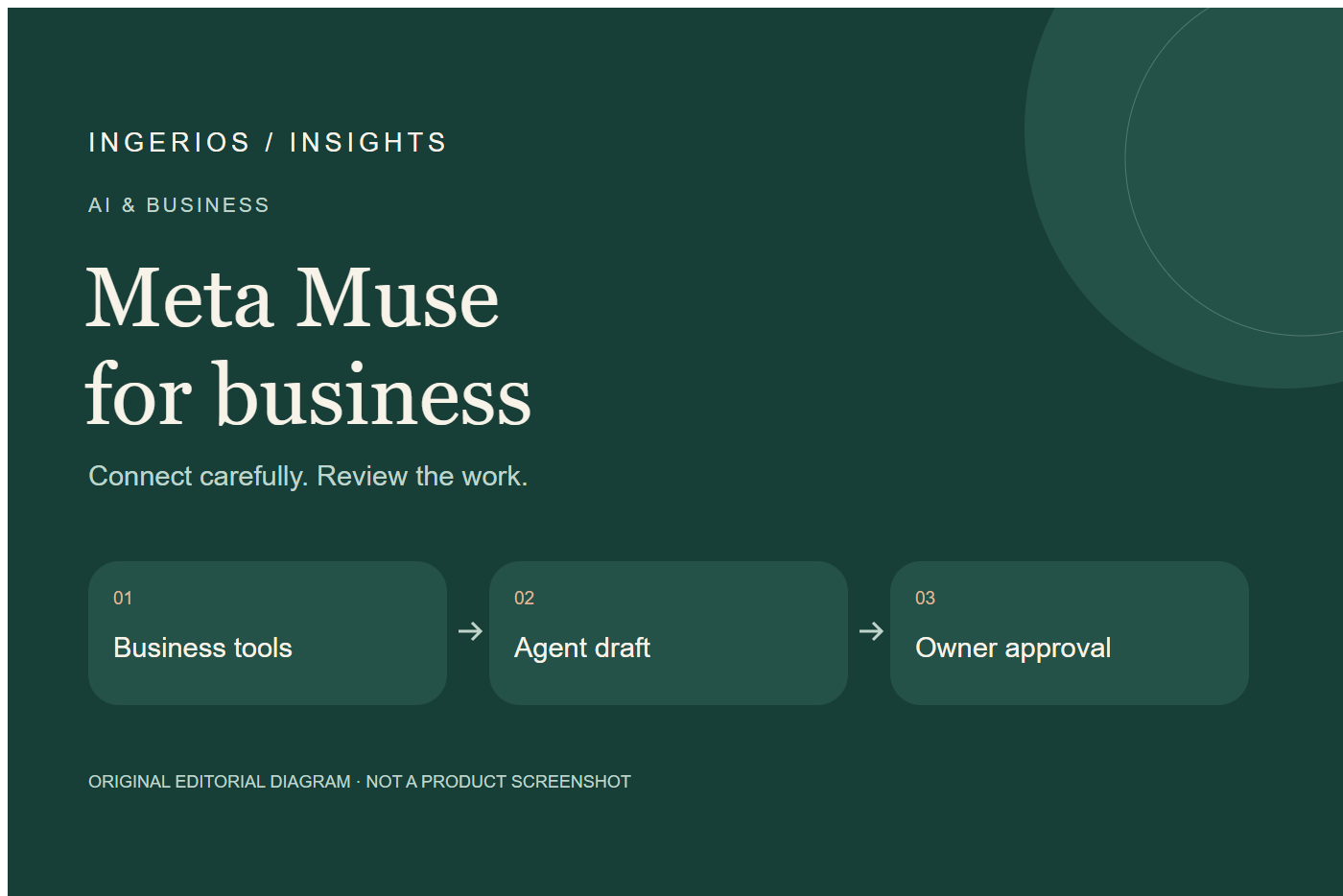
In our proposed workflow, a person checks prices, stock, customer promises and brand tone. Any action involving a payment, public message or customer account gets an explicit owner. A convenient draft can still contain an inaccurate claim, and a technically completed task can still be the wrong business decision.
Meta’s security discussion acknowledges that agents can make mistakes and encounter malicious instructions in material they read. For a practical pilot, keep a short record of what was requested, what was produced and what the reviewer changed. That record makes improvement easier to assess.
When should you keep using it?
Continue only if the completed work is consistently useful and the effort saved exceeds the effort added. If the reviewer repeatedly has to reconstruct the brief, simplify the task or stop the experiment. Popularity is a reason to investigate; your own results should determine adoption.
Ingerios can help you define a small AI workflow, its review steps and the measurements that would justify expanding it.
Sources and editorial note
- Meta’s small-business announcement · September 29, updated October 8, 2026
- Reuters: launch and download estimate · September 29, 2026
- Meta Research: agent security and safety
Original article based on public announcements and documentation. Recommendations are Ingerios analysis, not results from a product test or a paid partnership. Availability may change.